Understanding Hospital-Acquired Infections
Hospital-acquired infections (HAIs), also known as healthcare-associated infections, are the infections that patients get while they are in the hospital. These infections typically appear 48 hours or more after admission. In developed countries, HAIs contribute to 7% of cases, while in developing countries, the figure is 10%. HAIs increase hospital stays, cause disabilities, and create economic burdens (Khan et al., 2017). Each year, a population equal to that of the entire United States acquires an HAI, with nearly 1 in 31 hospital patients affected by at least one infection. Middle-income countries have the highest annual burden, with almost 119 million cases (Balasubramanian et al., 2023).
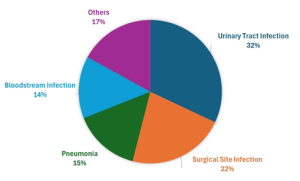
India is one of the countries that bears the burden of high Hospital-acquired infections (HAIs) cases. A study across 947 hospitals found that 19.5% of ICU patients had at least one HAI (HAIs: Reports and Data, n.d.). ICU patients are at higher risk of acquiring HAIs and multidrug-resistant pathogens. These infections are increasing by time due to increase in hospitalisation cases, more complex healthcare treatments, and the growing complexity of patient’s conditions. HAIs occur worldwide and lead to significant avoidable healthcare costs. Many of the pathogens are already present in hospital environments and can easily spread from one patient to another due to poor infection control practices by caregivers or facilities (Jayasree & Afzal, 2019).
Table 1: Common pathogens and risk factors for hospital-acquired infections
Category | Details | |
Risk factors for HAIs | – Immunosuppression | |
Common pathogens for HAIs | Clostridium difficile | Causes Clostridium difficile colitis |
Central Line-Associated Bloodstream Infections (CLABSI) | – Candida spp. (adult ICU) | |
Catheter-Associated Urinary Tract Infections (CAUTI) | – Enterococcus | |
Surgical Site Infections (SSI) | – Staphylococcus aureus | |
Hospital-Acquired Pneumonia (HAP) and Ventilator-Associated Pneumonia (VAP) | – Staphylococcus aureus | |
Paediatric Pathogens (HAP/VAP) | – E. coli | |
Control Strategies and Difficulties in India’s HAI War
India faces huge challenges in controlling hospital-acquired infections (HAIs) due to its large population and the high demand for in-patient care. Many healthcare facilities, both public and private, struggle with poor infection prevention and control (IPC) practices (Murhekar & Kumar, 2022). India’s healthcare system is under-resourced, especially in rural areas, making it difficult to maintain proper hygiene. Hospitals are often overcrowded, and infection prevention tools like disinfectants, personal protective equipment (PPE), and sterilization equipment are limited.
The widespread use of antibiotics has also contributed to antimicrobial resistance (AMR), making it harder to control infections. Additionally, there is a lack of training among healthcare staff and patients about proper hygiene practices. Many rural healthcare facilities are poorly equipped for effective IPC, leading to higher risks of cross-contamination (Joshi et al., 2018).
A study on IPC measures in Indian hospitals found that 59% of hospitals had moderate IPC practices, while 13% had basic-level practices (Katoch et al., 2022). Hospitals that adopted multimodal approaches, such as staff education, guideline compliance, and quality improvements, saw lower rates of HAIs. This shows the need for continuous strengthening of IPC measures and regular monitoring (Katoch et al., 2022). Surveillance of HAIs and AMR is critical, as AMR is projected to cause 10 million deaths annually by 2050. Programs like antimicrobial stewardship (AMS) are vital in managing this growing threat (Maki & Zervos, 2021).
Innovative Solutions and Technology in Infection Prevention and Control
Advancing technology has brought new, innovative approaches to infection prevention and control (IPC) in hospitals and healthcare facilities (Table 2). Mobile applications and surveillance software are now essential tools for tracking hospital-acquired infections (HAIs) in real time. These technologies enable healthcare providers to collect and analyze infection data faster, improving their ability to contain outbreaks. For example, the CDC’s National Healthcare Safety Network (NHSN) offers a large-scale, data-driven framework that helps hospitals monitor infections and support existing practices and policies.
Another important development is the use of UV light sterilization, which has largely replaced traditional cleaning methods. UV-C sterilization machines are highly effective at killing bacteria and viruses, offering a powerful solution to reduce viral infections in hospitals (Santos & de Castro, 2021). Studies show that these machines can significantly improve hospital hygiene by directly targeting harmful pathogens.
The COVID-19 pandemic further accelerated the adoption of telemedicine. Telehealth services help reduce in-person contact, lowering the risk of pathogen transmission. Patients can consult with doctors remotely, receive prescriptions, and avoid unnecessary exposure to infection (Dorsey & Topol, 2020). This not only protects patients but also eases the burden on healthcare facilities by reducing the need for in-person visits. Telemedicine platforms also help manage healthcare resources more efficiently, ensuring that hospitals can prioritize cases requiring physical interaction.
Together, these technological advancements provide a comprehensive approach to IPC, making healthcare environments safer. They improve real-time tracking of infections, enhance decontamination methods, and minimize the risk of physical contact, all of which contribute to a more effective healthcare system.
Table 2: Recent advancements in the management of HAIs
Method | Effectiveness | Limitations | Optimal use cases | Examples in practice |
Traditional cleaning | Effective for visible soil removal and initial microbial reduction but may leave microscopic pathogens. | Labor-intensive, may miss hard-to-reach areas, and requires strict adherence to protocols for optimal results. | Daily cleaning, especially for organic soil removal and initial disinfection in all hospital areas. | Mop and wipe-down procedures, use of Environmental Protection Agency (EPA) approved disinfectants for healthcare settings. |
UV-C sterilization | High effectiveness in inactivating pathogens on surfaces, with up to 90% reduction in specific bacteria, effective for high-touch areas. | Best as a secondary measure, it requires clear line-of-sight exposure; surfaces need to be free of organic matter. | Adjunct to traditional cleaning, especially in high-risk areas like ICUs, operating rooms, and isolation rooms. | UV-C robots and stationary units in patient rooms and operating theatres post-manual cleaning. |
Antimicrobial coatings | Provides continuous microbial resistance on surfaces, reducing bacterial loads over extended periods, but varies with coating type. | Limited efficacy on porous surfaces, potential wear over time, may require reapplication or maintenance. | Long-term protection for high-touch surfaces in patient rooms, common areas, and locations with frequent contact. | Copper, silver ion, or antimicrobial polymer coatings on frequently touched surfaces like door handles and bed rails. |
Recommendations
In order to ensure that HAIs are prevented from occurring in the first place, healthcare facilities should incorporate IPC measures. Key recommendations include:
- Establish infection control programs: Establish and operationalize functional hospital-specific Infection Control Committees (HICCs) for the discharge of IPC functions, policy making and implementation of guidelines as spelt out by the national body.
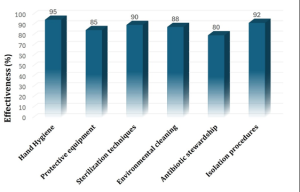
- Adhere to standard precautions: The measures are appropriate hand washing techniques, gloves or any other protective clothing, safe disposal of used injections and sharps and management of wastes in general.
- Regular surveillance: Supervise and record infection incidence in the facility for purposes of evaluating IPC measures and triggering investigations for possible enhancement.
- Implement AMS programs: Combat AMR through prescription regulation by setting standards for procedures for the correct usage of antibiotics.
- Continuous education and training: Healthcare workers should undergo refresher IPC training on the existing IPC threats and new IPC challenges effectively and enforce IPC compliance to improve patient safety.
- Maintain environmental hygiene: Hospitals should periodically clean and disinfect hospital surroundings, such as patient accommodation, operating theatre, and machines, to minimize the spread of pathogenic organisms.
- Implement isolation protocols: Avoid cross spread of infection to other patients by isolating such patients using the right isolation rooms and adhering to specific infection control measures.
- Promote hand hygiene compliance: Promote and enforce the proper use of hand washing by the health care providers.
Conclusion
India faces unique challenges such as infrastructure differences, lack of availability of resources and awareness towards Hospital-acquired infections (HAIs), making IPC a crucial dimension to HAI control. The adoption of a comprehensive, multi-faceted approach that includes improvements in sanitation and hygiene practices, alongside training for healthcare staff on IPC guidelines, will ensure more rigorous implementation of standardized protocols coupled with periodic monitoring, which could go far to bring about a reduction in HAI-related infection rates. Recent advancements, such as antimicrobial coatings, UV-C sterilization, and regular cleaning, offer promising solutions to enhance IPC effectiveness and minimize infection risks. It is also important to invest in technology for rapid diagnostics, procure more personal protective equipment and ensure effective awareness campaigns are carried out. Moreover, it is crucial that healthcare providers and policymakers come together & partner with the public to build a culture of infection prevention. While India continues to work on improving its healthcare practices, strong IPC measures can save lives and enable patient confidence and trust, along with savings from Hospital-acquired infections (HAIs).
References
Balasubramanian, R., Van Boeckel, T. P., Carmeli, Y., Cosgrove, S., & Laxminarayan, R. (2023). Global incidence in hospital-associated infections resistant to antibiotics: An analysis of point prevalence surveys from 99 countries. PLOS Medicine, 20(6), e1004178. https://doi.org/10.1371/journal.pmed.1004178
HAIs: Reports and Data. (n.d.). Centers for Disease Control and Prevention. Retrieved November 5, 2024, from https://www.cdc.gov/healthcare-associated-infections/php/data/index.html
Jayasree, T., & Afzal, M. (2019). Implementation of Infection Control Practices to Manage Hospital Acquired Infections. Journal of Pure and Applied Microbiology, 13(1), 591–597. https://doi.org/10.22207/JPAM.13.1.68
Joshi, S. C., Diwan, V., Joshi, R., Sharma, M., Pathak, A., Shah, H., Tamhankar, A. J., & Stålsby Lundborg, C. (2018). “How Can the Patients Remain Safe, If We Are Not Safe and Protected from the Infections”? A Qualitative Exploration among Health-Care Workers about Challenges of Maintaining Hospital Cleanliness in a Resource Limited Tertiary Setting in Rural India. International Journal of Environmental Research and Public Health, 15(9), 1942. https://doi.org/10.3390/ijerph15091942
Katoch, O., Katyal, S., Srivastav, S., Rodrigues, C., Rupali, P., Chakrabarti, A., Ray, P., Tak, V., Biswal, M., Nath, R., Mukhopadhyay, C., Bhattacharya, S., Padmaja, K., Deotale, V., Venkatesh, V., Wattal, C., MA, T., Nag, V. L., Ray, R., … Mathur, P. (2022). Self-reported survey on infection prevention and control structures in healthcare facilities part of a national level healthcare associated infection surveillance network in India, 2019. American Journal of Infection Control, 50(4), 390–395. https://doi.org/10.1016/j.ajic.2021.09.019
Khan, H. A., Baig, F. K., & Mehboob, R. (2017). Nosocomial infections: Epidemiology, prevention, control and surveillance. Asian Pacific Journal of Tropical Biomedicine, 7(5), 478–482. https://doi.org/10.1016/j.apjtb.2017.01.019
Maki, G., & Zervos, M. (2021). Health Care–Acquired Infections in Low- and Middle-Income Countries and the Role of Infection Prevention and Control. Infectious Disease Clinics of North America, 35(3), 827–839. https://doi.org/10.1016/j.idc.2021.04.014
Murhekar, M. V., & Kumar, C. G. (2022). Health-care-associated infection surveillance in India. The Lancet Global Health, 10(9), e1222–e1223. https://doi.org/10.1016/S2214-109X(22)00317-5
Santos, T. dos, & de Castro, L. F. (2021). Evaluation of a portable Ultraviolet C (UV-C) device for hospital surface decontamination. Photodiagnosis and Photodynamic Therapy, 33, 102161. https://doi.org/10.1016/j.pdpdt.2020.102161
Balasubramanian, R., Van Boeckel, T. P., Carmeli, Y., Cosgrove, S., & Laxminarayan, R. (2023). Global incidence in hospital-associated infections resistant to antibiotics: An analysis of point prevalence surveys from 99 countries. PLOS Medicine, 20(6), e1004178. https://doi.org/10.1371/journal.pmed.1004178
HAIs: Reports and Data. (n.d.). Centers for Disease Control and Prevention. Retrieved November 5, 2024, from https://www.cdc.gov/healthcare-associated-infections/php/data/index.html
Jayasree, T., & Afzal, M. (2019). Implementation of Infection Control Practices to Manage Hospital Acquired Infections. Journal of Pure and Applied Microbiology, 13(1), 591–597. https://doi.org/10.22207/JPAM.13.1.68
Joshi, S. C., Diwan, V., Joshi, R., Sharma, M., Pathak, A., Shah, H., Tamhankar, A. J., & Stålsby Lundborg, C. (2018). “How Can the Patients Remain Safe, If We Are Not Safe and Protected from the Infections”? A Qualitative Exploration among Health-Care Workers about Challenges of Maintaining Hospital Cleanliness in a Resource Limited Tertiary Setting in Rural India. International Journal of Environmental Research and Public Health, 15(9), 1942. https://doi.org/10.3390/ijerph15091942
Katoch, O., Katyal, S., Srivastav, S., Rodrigues, C., Rupali, P., Chakrabarti, A., Ray, P., Tak, V., Biswal, M., Nath, R., Mukhopadhyay, C., Bhattacharya, S., Padmaja, K., Deotale, V., Venkatesh, V., Wattal, C., MA, T., Nag, V. L., Ray, R., … Mathur, P. (2022). Self-reported survey on infection prevention and control structures in healthcare facilities part of a national level healthcare associated infection surveillance network in India, 2019. American Journal of Infection Control, 50(4), 390–395. https://doi.org/10.1016/j.ajic.2021.09.019
Khan, H. A., Baig, F. K., & Mehboob, R. (2017). Nosocomial infections: Epidemiology, prevention, control and surveillance. Asian Pacific Journal of Tropical Biomedicine, 7(5), 478–482. https://doi.org/10.1016/j.apjtb.2017.01.019
Maki, G., & Zervos, M. (2021). Health Care–Acquired Infections in Low- and Middle-Income Countries and the Role of Infection Prevention and Control. Infectious Disease Clinics of North America, 35(3), 827–839. https://doi.org/10.1016/j.idc.2021.04.014
Murhekar, M. V., & Kumar, C. G. (2022). Health-care-associated infection surveillance in India. The Lancet Global Health, 10(9), e1222–e1223. https://doi.org/10.1016/S2214-109X(22)00317-5
Santos, T. dos, & de Castro, L. F. (2021). Evaluation of a portable Ultraviolet C (UV-C) device for hospital surface decontamination. Photodiagnosis and Photodynamic Therapy, 33, 102161. https://doi.org/10.1016/j.pdpdt.2020.102161